

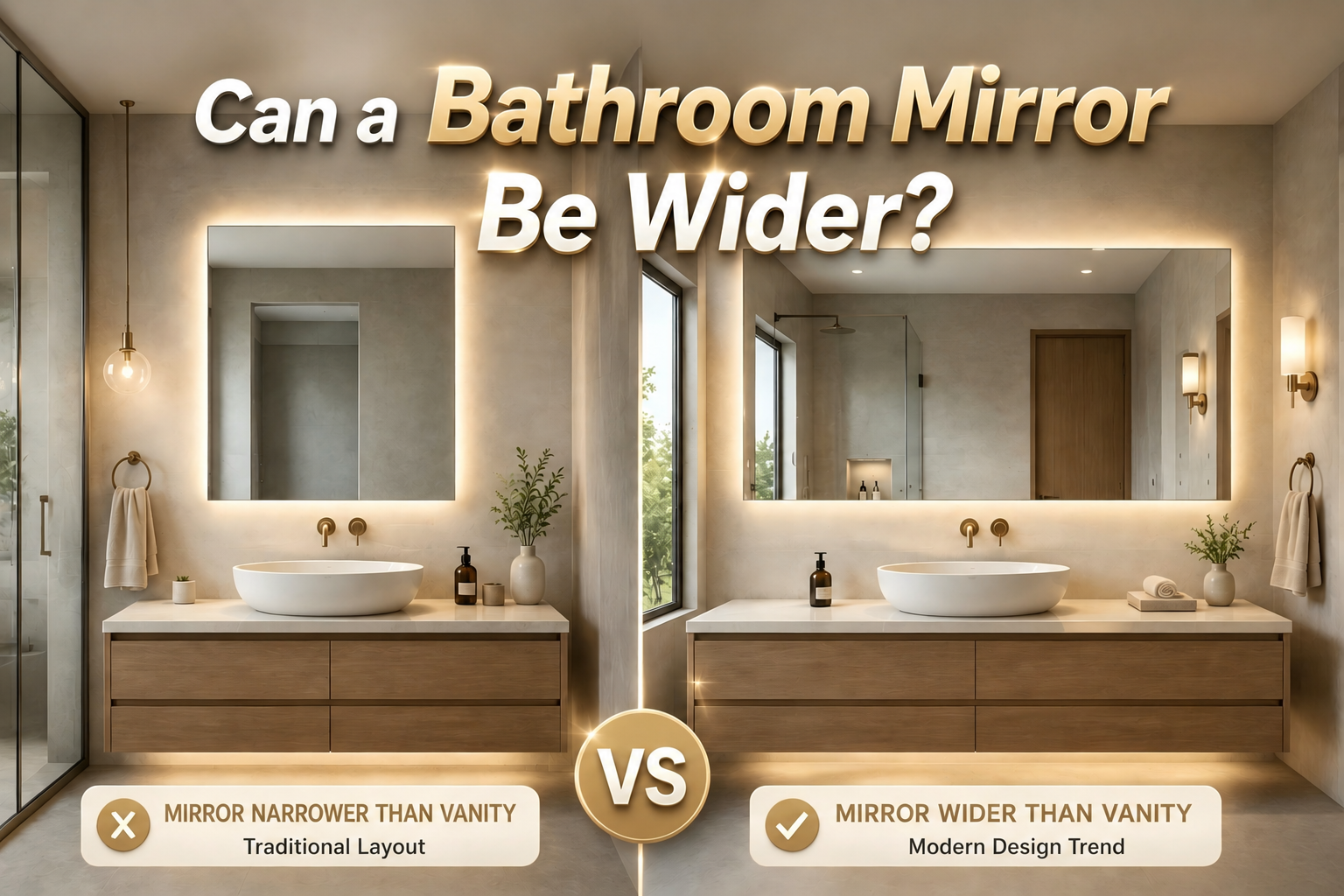
Bathroom mirror sizing plays an important role in bathroom design. The mirror affects visual balance, lighting performance, and the overall proportion of the vanity area. In residential and commercial projects, project teams often ask whether the bathroom mirror should match the vanity width or whether a larger mirror can create a better visual effect.
From a professional design perspective, there is no single fixed rule. The right mirror size depends on the bathroom layout, vanity style, lighting arrangement, and overall design concept.
Why Mirror Width Matters
The relationship between the mirror and vanity creates the main visual focus of the bathroom.
A mirror that is too small may make the vanity area feel incomplete, while a mirror that is too large can create a heavy appearance on the wall.
In many professional bathroom designs, designers usually keep the mirror width around 70%–80% of the vanity width, or approximately 2–4 inches narrower on each side. This proportion often creates the most balanced visual effect.
In most projects, designers usually choose one of these approaches:
Mirror slightly narrower than the vanity
Mirror matching the vanity width
Mirror wider than the vanity
A narrower mirror often creates a balanced and classic appearance. A mirror that matches the vanity width creates a cleaner and more modern look.
A wider mirror can also work well when the surrounding design supports it properly.
When a Wider Mirror Works Well
Modern bathroom projects increasingly use mirrors wider than the vanity, especially in minimalist interiors.
Wall-to-Wall Mirror Designs
Wall-to-wall mirrors are one of the most common examples.
Instead of placing a smaller mirror above the vanity, designers extend the mirror across most or all of the wall surface.
This design is popular in:
Hotels
Luxury apartments
Small bathrooms
Commercial washrooms
Wall-to-wall mirrors help increase light reflection and make bathrooms appear larger and brighter.
Floating Vanity Layouts
Floating vanities create lighter visual weight, which allows designers to use wider mirrors more naturally.
This layout works especially well with:
Frameless mirrors
Backlit LED mirrors
Thin frame mirrors
Many modern Australian bathroom projects use this combination to create a clean and minimalist appearance.
How Mirror Style Changes Visual Balance
Mirror style affects how width is visually perceived.
Frameless Mirrors
Frameless mirrors create a lighter appearance and work well in larger sizes. Because they do not have a heavy border, they usually feel less crowded on the wall.
Framed Mirrors
Framed mirrors create stronger visual weight. Thick black, gold, or decorative frames often look better when the mirror remains slightly narrower than the vanity.
LED Bathroom Vanity Mirrors
LED mirrors create illuminated borders around the mirror surface, which visually increases mirror size.
Because of this, many project teams prefer LED bathroom vanity mirrors that are slightly narrower than the vanity. This creates better wall lighting effects and improves visual proportion.
Double Vanity Considerations
Double vanity layouts usually use either:
Two separate mirrors
One large shared mirror
Two mirrors create stronger symmetry, while one large mirror creates a cleaner modern appearance.
In most projects, designers align the mirror with the outer edges of the vanity instead of extending it significantly wider.
Professional Project Considerations
Mirror sizing is not only a design decision. Project teams also need to consider:
Glass thickness
Safety requirements
Installation method
Moisture resistance
LED electrical safety
Wall structure
For developers, hotel projects, and large-scale residential programs, standard mirror sizes may not always match vanity layouts or lighting plans. Because of this, many project teams prefer OEM custom bathroom mirrors for better project coordination.
Custom production helps improve alignment between the mirror, vanity, lighting, and installation requirements. It also supports bulk purchasing consistency for hotels, apartments, and commercial developments.
Conclusion
A bathroom mirror can be wider than the vanity when the overall design supports the proportion correctly.
Wall-to-wall mirrors, floating vanity layouts, and minimalist interiors often use wider mirrors successfully. However, in many standard bathroom projects, mirrors that are slightly narrower than the vanity still create the most balanced appearance.
For architects, designers, consultants, and contractors, successful bathroom mirror design depends on balancing proportion, lighting, installation, and overall interior style.